Why a Wider Pan Changes the Pace of a Sauce
Learn how a wide pan affects sauce evaporation and concentration, so you can choose a skillet or saucepan that suits the sauce and the attention you can give it.
How do you choose a pan for sauce reduction without letting the sauce get ahead of you? A wide pan exposes more sauce to air, so it can lose water more readily than the same amount in a narrow saucepan. That can speed concentration, but it also means you may need to watch more closely.
Pan width changes the exposed surface
Evaporation happens where liquid meets air. In a wide skillet, a shallow layer of sauce exposes more liquid than the same amount would in a narrow saucepan. Under otherwise similar conditions, that larger exposed surface can help the sauce reduce more readily.
Other conditions matter too: burner strength, pan material, the amount of sauce, and whether you stir. Pan width changes one part of the cooking environment, not the whole process.
As water evaporates, the remaining sauce has a greater share of ingredients such as salt, sugar, acids, fat, and flavor compounds. That concentration may make it taste more intense or feel thicker. The change depends on the sauce; thickening can also come from starch, fat, or other ingredients without much water loss.
A wide skillet can concentrate sauce quickly
A wide skillet can help when a sauce needs to lose excess water without simmering for a long time. Its broad surface gives vapor room to escape and spreads the liquid into a thinner layer. A tomato pan sauce, a butter-and-stock reduction, or a skillet sauce made after browning food may suit this shape.
The same exposed surface can leave less time to respond. As liquid thins, solids may cling to the pan, and flavors can become more intense. A sauce that seemed loose can turn sticky or too concentrated if it continues cooking unattended.
Watch several signs together: whether the liquid level is falling, how the bubbles rise and break, and how readily the sauce coats a spoon. These are clues, not exact tests. A spoon drawn across the bottom may leave a brief opening, but that trail varies with the sauce, pan, and stirring; use it as one observation rather than a precise measure of doneness.
A narrow saucepan gives a slower pace
A narrow, deeper pan exposes less surface for a given volume of sauce. That often slows evaporation, which can help when a liquid needs time to warm, meld, or simmer without concentrating too quickly. Broths, cream sauces, and sauces that call for gentle reduction may be easier to monitor in this shape.
Depth also affects circulation and heating. Liquid may behave differently at the center than near the edges, depending on the burner and pan. Stirring helps redistribute heat and ingredients, but it does not make every pan behave the same way. A heavy saucepan can retain heat after it leaves the burner, so the sauce may keep thickening during a pause.
A narrow pan is not automatically gentle. High heat can produce vigorous bubbling, and a small amount of liquid may still reduce quickly. Choose a shape that supports the pace you want, then adjust the heat and observe the sauce.
Match the pan to the sauce’s job
Start by asking what the sauce needs to do. If it needs to lose water and become more concentrated, a wide pan may help. If it needs a slow simmer, a steady volume, or time for ingredients to soften, a narrower pan may be easier to manage.
- Quick skillet sauce: If a modest amount of liquid needs to coat cooked food, use a broad pan and controlled heat; if it starts drying against the surface, lower the heat or add a splash of stock.
- Large amount of thin liquid: If the liquid sits deep in a wide pot, divide it between pans when practical; otherwise, expect the deep layer to reduce less readily and check its level as it simmers.
- Dairy sauce or delicate emulsion: If the texture needs gentle handling, use a pan that gives you time to adjust the heat; if it begins to separate or thicken too quickly, lower the heat and stir rather than chasing rapid evaporation.
- Already-thick sauce: If the sauce is dense before it reaches the pan, favor a deeper pan and lower heat; if it begins sticking, loosen it with a little liquid and reassess.
- Salty or acidic sauce: If reduction makes the flavor too sharp or salty, stop concentrating it and consider adjusting with a suitable unsalted liquid or other recipe ingredients.
- Starchy sauce: If it thickens before the liquid level changes much, treat texture and evaporation as separate cues; if it becomes too dense, add liquid rather than assuming it needs a different pan.
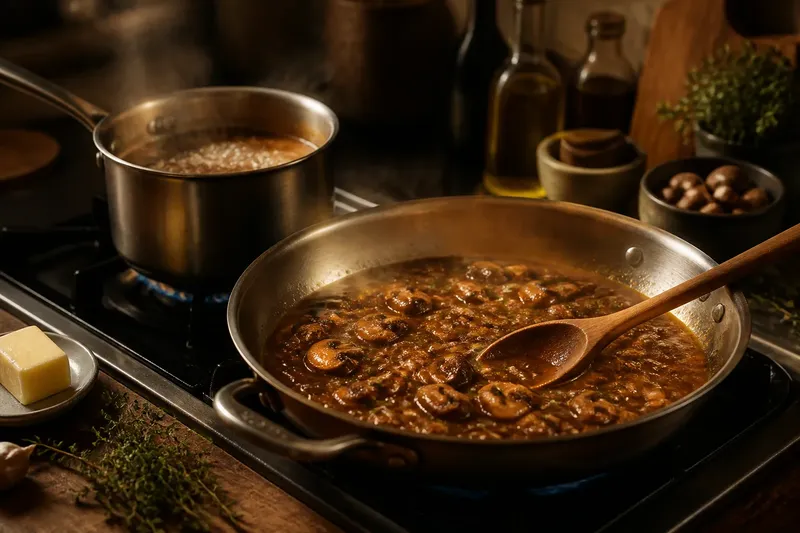
Imagine you have a cup of thin stock left in a skillet after cooking mushrooms, and you want a glossy sauce. You keep the broad skillet over moderate heat, stir in a small knob of butter, and watch the sauce coat the mushrooms more clearly as the liquid reduces. If it starts looking tight before the mushrooms are ready, you lower the heat and add a splash of stock. The result is a looser sauce that still coats the mushrooms, rather than one that keeps concentrating while you finish the dish.
Heat and ingredients can change the result
Surface area is a guide, not a promise. A larger quantity can cover the bottom more deeply, limiting the advantage of a wide pan. A small amount may spread into a thin film and reduce quickly. The relationship between pan shape and the amount of liquid is more useful than the pan’s label alone.
Heat input matters as well. Turning up the burner can intensify bubbling and evaporation, but it also increases the risk of scorching, especially when sugars, starches, or milk solids settle. Lower heat may make gradual changes easier to observe. When switching pans, reassess the heat rather than carrying over the same setting automatically.
Ingredients affect how concentration feels. Salt and acids become more noticeable as water leaves. Starch can thicken a sauce before much evaporation occurs, while fat can make it seem smooth and rich without concentrating it in the same way. A thicker sauce is not always a substantially reduced sauce.
What signs show that sauce is reducing?
What does reduction look like?
The liquid level may fall, bubbles may change in size or behavior, and the sauce may coat a spoon more readily. Treat these as clues to read together, not as fixed thresholds; sauce composition and heat affect what each sign looks like.
Does a wider pan always make sauce thicker?
No. A wide pan can encourage water loss, but thickness also depends on starch, fat, gelatin, and other ingredients. A sauce may remain thin if it has little water to lose or is heated gently.
Can you reduce sauce in a narrow saucepan?
Yes. It may take longer because less surface is exposed, but simmering and occasional stirring can still concentrate the liquid. That slower pace can help when you want more time to monitor the sauce.
Should you cover the pan?
A lid traps much of the escaping vapor, so less water leaves the sauce. Leave the pan uncovered when reduction is the goal; cover it when retaining moisture matters more, then reassess after removing the lid.
Choose a pan for the pace you can monitor
Pan width helps you anticipate how much attention a sauce may need. A broad skillet favors exposure and can encourage faster concentration; a narrower saucepan tends to retain liquid and may give you more time. Neither shape determines the result by itself.
For sauce reduction, begin with the amount of liquid, the texture you want, and how closely you can stay with the pan. The effect of a wide pan is easiest to manage when you can see the sauce and respond as it changes. Treat the spoon trail as a supporting clue, not a doneness verdict, and choose the pan that lets you make the next adjustment in time.