Before the Recipe Card: How Cooking Instructions Traveled
Cooking instructions once traveled by voice, memory, and demonstration. Learn what written recipes preserve and how to interpret the judgment they leave to cooks.
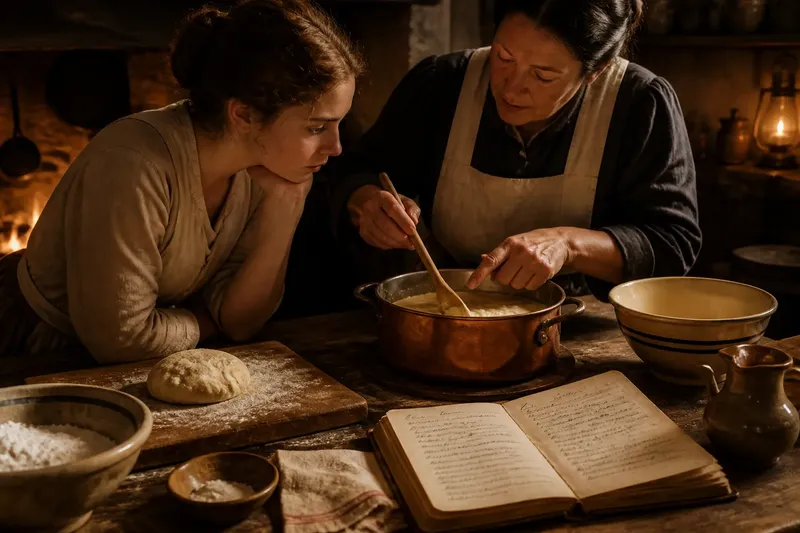
How did a cook follow cooking instructions before a recipe card could be passed across a table? Often, a learner watched another person work, listened to directions, and practiced with ingredients and tools at hand. That scene is a useful way to understand one kind of teaching, not a complete account of how every community shared cooking knowledge.
Demonstration makes sensory directions visible
Imagine a learner watching a cook stir a pot and hearing, “Keep going until it looks right.” The sentence becomes more helpful when both people can see the same mixture. The learner can ask what “right” means, while the cook points to its texture, slows the stirring, or shows when to stop.
A live demonstration can combine words with timing, gesture, smell, and touch. A teacher might show how a dough feels when it is workable or how a simmer differs from a hard boil. Those cues are difficult to convey in a short written direction, though a learner still needs practice to recognize them independently.
Memory can carry a method beyond the demonstration. A learner may recall the order of actions and adapt them to available ingredients or equipment. That retelling can preserve a familiar household version, but it may also change as cooks make choices about texture, flavor, and technique. The precise path of any particular method depends on its people and setting.
Written recipes preserve selected details
A written recipe can record ingredients, sequence, and a name for a preparation. A cook can return to the page later or share it with someone who did not attend the original demonstration. What writing preserves depends on what its author chooses to include.
The page cannot see the cook’s bowl or notice a misunderstanding as it happens. A direction such as “bake until done” gives little indication of the intended appearance. The reader must interpret the wording, observe the food, and decide whether the instruction fits the conditions in front of them.
Writing also requires choices about detail. An author might specify when to add an ingredient, describe a change in texture, or leave those points unstated. A spare recipe may make sense to a reader who already knows the dish; another reader may need explanation. Without evidence about a specific recipe and its audience, it is safer to treat those omissions as clues to investigate, not proof of why the author left them out.
Every record leaves some knowledge outside the text
A recipe preserves only what it records. “Stir constantly” gives an action, but may not explain what the cook is trying to prevent. An ingredient list names components without necessarily saying how to select, prepare, or judge them.
Written directions also rely on shared meanings. Readers may recognize terms such as chopped, folded, or reduced, but their prior experience shapes how they interpret them. A recipe can travel beyond its original setting while still depending on knowledge the new reader does not have.
Say a reader finds a handwritten note that says, “Add milk slowly; stop when it holds.” The note supplies an order and a sensory clue, but not a precise account of the original cook’s mixture. The reader adds milk in small pours and watches how the mixture changes. The observable result is a texture that can be compared with the phrase “holds,” although it may not match the original cook’s result exactly.
Read an inherited recipe for what it states and assumes
Start by separating explicit directions from open questions. Note which ingredients appear, when they enter, and what change the recipe asks you to observe. Then mark vague phrases such as “until tender” or “add enough water.” They name a goal or action without specifying every detail needed to reproduce it.
For each open question, identify what information would help: a description of the intended texture, the kind of vessel, or the meaning of an unfamiliar term. Seek a reliable explanation of the technique when needed. For food-safety questions, use current guidance from an appropriate public health authority rather than guessing from an inherited phrase.
If you annotate a family or community recipe, keep the original wording distinct from your additions. Record what you observed, the tool you used, or a term someone explained. That distinction lets a later reader see which details came from the earlier record and which came from a new interpretation.
Different media show different parts of a method
A method can be shared through spoken instruction, repeated practice, a handwritten reminder, a printed recipe, a broadcast, a video, or a digital page. These forms are not interchangeable. A written page is easy to scan and mark up; a video can show a hand’s pace or a mixture’s appearance; a live demonstration lets a learner ask questions as the work proceeds.
Each medium also has limits. A screen cannot carry aroma or the feel of dough under a hand. A written direction may preserve an order of operations but leave a movement unexplained. The cook still has to compare the instruction with what is happening in the kitchen.
Questions readers ask about cooking instructions?
Why do some older recipes leave out amounts?
A recipe may assume its reader already knows the dish or can judge quantities by sight and feel. Without evidence about the writer and audience, an omission alone cannot tell us why an amount is missing.
Can a recipe preserve the original cook’s exact method?
It can preserve the details its writer recorded, but a text may not capture every movement, sensation, or adjustment. Later notes can add context as long as they remain distinct from the original wording.
What can I do when a direction is unclear?
Identify what the sentence specifies and what it leaves open, then consult a reliable explanation of the technique or ask someone familiar with it. For food-safety questions, follow current guidance from an appropriate public health authority.
Cooking instructions still ask readers to make judgments
Spoken directions, demonstrations, handwritten notes, and printed recipes each preserve different parts of a method. The most useful question is not whether one form is complete, but what the particular instruction lets a reader know and what it expects them to supply.
Before setting aside an old recipe, add one clear note about a turning point you observed, such as how the mixture looked when you stopped stirring. That small record can clarify a gap for the next reader without pretending to recover details the original text never gave. It is a modest way to make cooking instructions easier to interpret while keeping their history visible.